
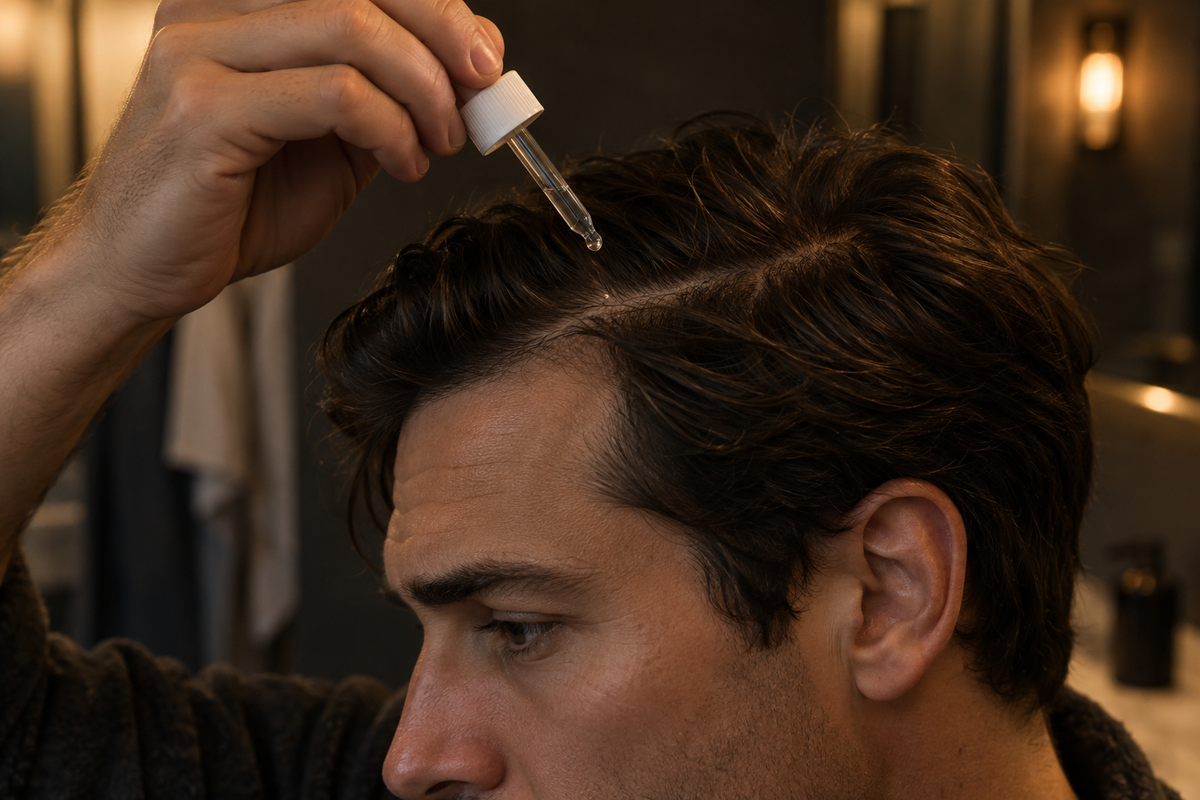
Minoxidil has a real track record treating dormant hair patches and early thinning. That said, you’re likely to walk around looking like you’ve been groomed by a momma cat or dusted with a white flaky residue in your hair if you haven’t mastered the application technique yet.
There's also the question of which formula fits your biology and lifestyle better. Because even though both foam and liquid formulas contain the same active medicine, it's the inactive ingredients that cause most of the trouble.
To help you find your matching formula, we’re breaking down the common frustrations, and a couple of how-tos along the way. We’ve even put together a quick needs analysis checklist that’ll put you on the right track.
Key Takeaways
- Foam and liquid are EQUALLY effective when it comes to hair regrowth, according to research.
- If you have very sensitive skin, use the 5% solution sparingly as it can cause irritation due to an ingredient called propylene glycol.
- Foam minoxidil dries in a flash because its carrier evaporates super fast. Make sure you get it onto your skin instead of leaving it on your hair to avoid the dandruffy residue.
- Rootique is a mist-based minoxidil applicator that parts your hair with tiny combs and shoots a fine micro mist straight onto your scalp as you slide it over your head, without soaking the hair strands.
- With consistent use, you’ll start to see results in 2 to 3 months, right after the initial “dread shed” phase.
Minoxidil Foam vs Liquid: Which One is More Effective?
When it comes to effectiveness, research has established that both the liquid and foam formulas are EQUALLY EFFECTIVE for regrowing hair, and there is absolutely no scientific backing that argues the opposite. They’re just made for different people with different needs.
Minoxidil Foam vs Liquid: Which is Better For You?
Before we dive into the details, let's check out a few factors to see which one is your best match. (Don't forget to consult your doctor for professional medical advice, too!)
You’ll appreciate the foam form of minoxidil if:
- Your hair loss spans a wider area of the crown instead of one small spot.
- You have a history of itching, redness, or flaking from the liquid carrier.
- You want to avoid greasiness and unnatural shine.
- You want the formulation specifically optimized to minimize facial hair side effects and skin irritation for female-pattern thinning.
- You want a quick-drying formula that won't mess up your daily hair styling routine.
You’ll appreciate the liquid form of minoxidil if:
- You want to save money in the long run.
- You are targeting a specific, isolated thinning patch and need a precision dropper to get past your hair straight to the scalp.
- You have no known sensitivity to propylene glycol or generally reactive skin.
- You are willing to trade a slightly greasier feel for more precise dropper placement.
Pro Tip: The biggest advantage of the foam formula is that it doesn’t make your hair look greasy. That said, if you prefer the liquid, you can use a micro-mist minoxidil applicator to avoid that notorious greasy feel of the liquid solution and get maximum results.
Minoxidil Foam vs Liquid: Application Challenges and Frustrations
| 5% Liquid | 2% Liquid | 5% Foam | Mist-based Application |
|
|---|---|---|---|---|
| Maximum hair growth | ✓ | ✗ | ✓ | ✓ |
| Sensitive skin comfort | ✗ | ✓ | ✓ | ✓ |
| Fast drying time | ✗ | ✗ | ✓ | ✓ |
| Long hair application | ✓ | ✓ | ✗ | ✓ |
| Zero facial runoff | ✗ | ✗ | ✓ | ✓ |
| Low monthly cost | ✓ | ✓ | ✗ | ✓ |
| No dandruffy residue | ✓ | ✓ | ✗ | ✓ |
| No greasy look | ✗ | ✗ | ✓ | ✓ |
Now that we’ve covered the tip of the iceberg, it’s high time we dive deeper into the frustrations you’re likely to experience with manual application, drying time, residue, and scalp sensitivity aspects of both the foam and liquid formulas.
Manual Application Challenges
Yes, it’s not very easy to get it right off the bat. If you haven’t used minoxidil yet, expect some facial runoff, and a little greasiness if you accidentally apply too much of it in one go.
The correct application of liquid minoxidil depends on how well you part your hair, and how well you steady a tube over a moving target.
If you squeeze it too hard, you’ll end up running to the shower to wash it off your face and neck. It takes a while for a lot of users to get it right. But hey—practice makes perfect! Or, alternatively, you can use a micro-mist applicator that converts liquid into mist to cover your entire scalp with minoxidil in under 15 seconds without soaking your hair. No manual application, and none of the problems that come with it.
Then as for the foam, you swap all the hassle of the traditional liquid application with a single squeeze into a cupped palm. That said, you’ll still need to part your hair very carefully and rub it on your scalp, avoiding the hair strands, so the formula doesn’t get stuck on them. Otherwise, the dried-up residue can look like a bad case of dandruff when it’s actually just minoxidil.
Drying Time and Residue
Another very common frustration you can experience is the greasy look of the liquid solution and the white residue the foam might leave on your hair roots.
Both formulas take around four hours to fully absorb, and the greasiness of the liquid won’t go away fast, especially with the twice-daily use.
Some users prefer washing their hair every four hours so they don’t pile up more shine, but that’s another frustration in itself.
By comparison, the foam dries up super fast, around 20-30 seconds max. That said, if you don’t apply it carefully, you’ll end up leaving a flaky, dandruffy residue on your hair. You need to fully massage it in within 30 seconds so it doesn’t dry up in your hair.
Scalp Sensitivity
Already dealing with a sensitive scalp? You might want to step away from the 5% extra strength solution, or Plan B…use it sparingly. If you fall into this camp, it’s best to either stick with the 2% formula, foam, or a mist-based application.
For context, the 2% regular strength solution is loaded with roughly 60% alcohol, while the 5% extra strength version swaps some of that out for 30% alcohol and 50% propylene glycol.
The 5% solution is generally the go-to recommendation for male pattern baldness because clinical studies show it produces up to 45% more hair regrowth than the 2% version. Having said that, unless you’re actively tackling male pattern baldness, it’s usually best to stick to the regular version for targeted spot treatments.
Now, as for the foam form, it dropped propylene glycol from the recipe in its entirety back in 2006, swapping it out for cetyl alcohol, stearyl alcohol, glycerin, and a tad bit of BHT. So, you won’t get irritation from the foam formula.
But keep in mind that it’s not absolutely hypoallergenic because it still contains alcohol and a pressurized propellant that can dry out already-sensitive skin. The rule of thumb is to do a 48-hour patch test behind your ear or on your inner arm with either the liquid or foam form before you start putting it all over your scalp.
Area Coverage
When it comes to area coverage, liquid is generally recommended for spot treatment because its precision dropper lets you target a specific thinning patch without wasting product on the surrounding hair.
By comparison, foam minoxidil is for people with shorter hair who want to cover the entire scalp with it. Yes, either way you’re making a trade-off: greasiness and potential scalp dryness with the liquid solution, or a bit of hair stiffness with the foam formula.
So which one should you go for? Both liquid and foam formulas have their pros and cons, and you’ll be forced into a trade-off either way. If you want the best of both worlds (the fast drying finish of the foam and the precision of the liquid) without the grease or residue, a micro-mist minoxidil applicator might just be it. It’s a total new-gen approach, and easily the most efficient minoxidil application method out there.
The Best Way to Apply Minoxidil for Maximum Effectiveness

For a completely hassle-free application, you can use Rootique, which is a mist-based minoxidil applicator, and forget about these frustrations for good.
To begin with, it turns liquid into a fine micro-mist with the IntelliMist technology and you get 3.5x more absorption than with manual application in just under 15 seconds.
The parting heads of the device automatically clear a path for your hair, so you can shoot the medicine right onto your scalp without soaking your hair strands. All you’re left to do is press a button and glide it all over your head.
What’s also very handy is that it’s compatible with 90%+ of water-based tonics and beeps every 1ml so you don’t over-apply and waste product on one area. And of course the best part is that a single charge goes a long way — up to 40 uses, to be exact.
Conclusion
Now that we’ve debunked the ubiquitous myth that foam minoxidil isn’t as effective as the liquid formula, let’s review some of the key points we've covered so far.
First and foremost, choosing the right formula comes down to how long and dense your hair is, and whether you’re allergic to propylene glycol.
If your primary concern is spot treatment and you aren’t allergic to the ingredient, the liquid form is the better fit for you. That said, if you need to cover your entire scalp, foam is the way to go. Just make sure you apply it straight to the skin to avoid that dandruff-like residue that usually happens when the foam gets caught in your hair.
Last but not least, if you want to make the absolute most out of your minoxidil, the Rootique DUO has a trick or two up its sleeve to help you apply it super fast, avoid the greasy feel, and stop wasting product.
Frequently Asked Questions
Is liquid minoxidil more effective than foam minoxidil?
Nope, they are equally effective. Clinical studies show that both forms work just as well at growing back hair. The real difference comes down to what they’re for. Liquids are better for precise spot-targeting but can be greasy, while foam dries quickly but can be tricky to get through longer hair.
What’s the proper way to apply minoxidil?
You want to apply it directly to a completely dry scalp, not your hair strands. If you're using the liquid, use the dropper to part your hair and target specific areas. If you're using the foam, massage it into your skin with your fingers. Once it's on, leave it alone for at least 4 hours before washing your hair or going to bed, and let it air-dry naturally without a blow dryer.
Why do I get dandruff after applying minoxidil?
Relax. You’re not getting actual dandruff, but rather a reaction to the ingredients. If you use the liquid, you might be allergic to propylene glycol, which causes a red, flaky rash called contact dermatitis. If you use the foam, it's often just dried-up residue from the product getting caught on your hair strands.
Why is my hair greasy after applying minoxidil?
The greasiness is almost always caused by the liquid version. Because minoxidil is stubborn to dissolve at a 5% strength, manufacturers have to load the liquid solution with propylene glycol. This chemical acts like an oil carrier, which leaves behind a heavy and greasy film on your scalp and hair.
How does Rootique DUO help dispense minoxidil?
When it comes to applying minoxidil, the Rootique DUO hits it out of the park and tackles the common grease vs dryness headache by controlling how minoxidil comes into contact with your scalp. Instead of dumping liquid or rubbing foam on your hair, Rootique uses tiny combs to physically part your hair sheaths while turning liquid minoxidil into a micro-mist. It then shoots the mist directly onto your skin to give you maximum absorption without the greasy mess or wasted product.
Share:
Rootique DUO vs. Rogaine Dropper: Which Actually Delivers Minoxidil to Your Scalp?
When Should You Apply Hair Serum: Wet Hair, Dry Hair, or After Washing?