
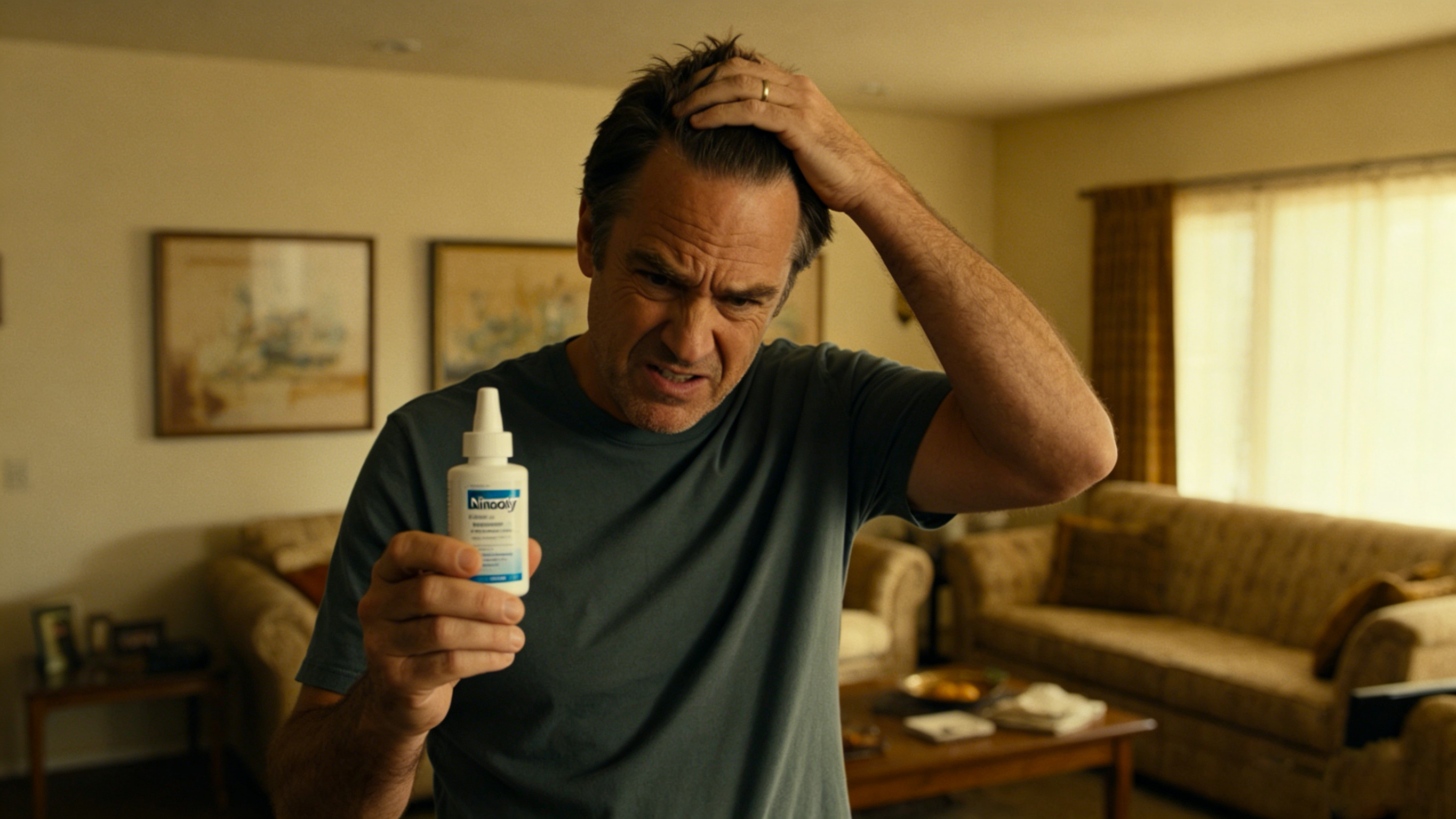
Quick Answer: Up to 90% of topical minoxidil users stop treatment before the 3–4 month threshold where results appear. The reasons are predictable — messy application, confusing initial shedding, missed doses, and the psychological difficulty of committing to a lifetime treatment. Each barrier has a specific, evidence-backed fix.
Hair loss treatment has a remarkable efficacy problem — not with the medicine, but with the people taking it.
Topical minoxidil is FDA-approved, clinically proven across decades of trials, and widely accessible without a prescription. It works for the majority of users who take it correctly and consistently. Yet the most-cited statistic in trichology practice isn't a success rate — it's a dropout rate. Studies consistently document that between 86–90% of topical minoxidil users discontinue treatment before reaching the 3–4 month minimum required for visible results.
The treatment works. The adherence system around it doesn't.
This guide breaks down the specific psychological, practical, and biological barriers that cause most minoxidil users to quit — and provides a concrete, evidence-based system for overcoming each one. If you've tried minoxidil before and stopped, or you're starting for the first time and want to maximize your odds of finishing the six-month commitment, this is the framework that changes outcomes.
The Dropout Map: Why 9 in 10 Users Quit
Before building a solution, it's worth being precise about the problem. The barriers to minoxidil adherence fall into five distinct categories, each peaking at a different stage of treatment.

Barrier 1: The Shedding Phase Panic (Weeks 3–8)
The most predictable and devastating dropout point. Minoxidil works by accelerating the hair growth cycle — specifically by forcing follicles in the resting (telogen) phase to transition into the growth (anagen) phase ahead of schedule. The old hair must be physically shed before new growth can begin. When many follicles enter this transition simultaneously (particularly in androgenetic alopecia, where an above-normal proportion are already in telogen), the result is a temporary spike in shedding often called the "dread shed."
In a randomized controlled trial of 5% minoxidil, researchers documented a temporary increase in shedding during weeks 2–12, followed by progressive improvement. The shedding is biological evidence that the treatment is working — minoxidil is cutting the telogen phase from 2–4 months down to approximately 1–2 days, triggering multiple follicles to shed and restart simultaneously.
The problem: nobody told most users this would happen. When hair loss appears to worsen in the first month, the rational conclusion — without context — is that the treatment is the cause. Studies show that patients who are warned about the dread shed in advance have substantially higher persistence rates than those who encounter it unexpectedly.
The fix: Know it's coming before it comes. The presence of a shedding phase at weeks 3–8 is a positive predictor of treatment response, not a failure signal. A 2025 retrospective study confirmed that users who experience early shedding show better outcomes at both 6 and 12 months.
Barrier 2: No Visible Results at One Month (The Patience Gap)
Pharmaceutical drugs are typically expected to produce results within days or weeks. Minoxidil follows the biology of the hair growth cycle — which runs on a multi-month timeline regardless of when treatment starts.
The clinical reality: most users don't see visible change until months 3–4. Fine vellus hairs appear earlier (around weeks 8–12) but are easily missed without close examination. The psychological experience of applying a treatment twice daily for 8–12 weeks and seeing no obvious change is one of the highest-risk dropout periods in the entire treatment course.
Research shows that among women who had never tried minoxidil, 39% cited concern about side effects, 29% cited cost worries, and 27% were concerned about lifetime commitment — but the most common reason among users who had started and stopped was "perceived lack of effectiveness," even in cases where the treatment was working as expected.
The fix: Measure objectively before you rely on subjective perception. Take a scalp photo under consistent lighting (same time of day, same angle, same distance) every two weeks starting from day one. Human perception of gradual change is unreliable — your mirror comparison is not a valid clinical instrument. A photo log at weeks 2, 4, 8, 12, and 16 provides actual data. Progress that is invisible to daily observation often becomes unmistakable in side-by-side photos.
Barrier 3: Messy, Inconvenient Application (Daily Friction)
This is the barrier that compounds over time. A twice-daily treatment that is messy, difficult, or time-consuming creates cumulative friction that erodes compliance gradually — not through a single decision to stop, but through a pattern of skipped doses that degrades to eventual abandonment.
Traditional topical minoxidil application methods create specific, documented friction points:
- Dropper application requires multiple cap-fills, careful placement to avoid dripping onto the hairline and hands, hand-washing after, and a 4-hour no-wash window that clashes with morning gym routines or evening hair care.
- Foam application dissolves quickly and feels easier initially, but doesn't reach the scalp through thick or long hair without careful part-by-part application.
- Both methods risk transferring minoxidil to hands, pillowcases, and surfaces — a significant concern for households with cats or dogs, as minoxidil is highly toxic to pets even in trace amounts.
A study on minoxidil adherence found that the application process itself — its messiness and time requirement — was the most commonly cited practical barrier among users who had discontinued treatment. The treatment didn't fail; the daily execution system did.
The fix: Reduce application friction to the point where it requires less cognitive effort than any other part of a morning or evening routine. Two specific behavioral approaches consistently improve adherence:
- Habit stacking: Anchor the minoxidil application to an existing non-negotiable daily behavior (brushing teeth, morning shower, evening skincare). A physical reminder at the trigger location (device on the bathroom counter next to the toothbrush) converts minoxidil from a decision into an automatic behavior.
- Precision application tools: A device that delivers a measured 1ml directly to the scalp without dripping, hand contamination, or multiple steps removes the primary logistical pain points. Scalp-directed micro-mist delivery eliminates surface runoff risk, hand contact, and the pet-safety hazard of open liquid exposure.
Barrier 4: Missed Doses and Inconsistent Timing
Even motivated users with good intentions miss doses. A twice-daily protocol requires 14 applications per week — over the course of a year, that's 730 applications. Real-world adherence data consistently shows that self-reported adherence overestimates actual dosing compliance.
Research identifies non-compliance as the most common reason patients don't see expected results. Missing one application daily effectively reduces annual dose exposure by 25% compared to twice-daily protocol. Over a 6-month treatment period, that cumulative under-dosing compresses the effective treatment timeline substantially.
The twice-daily requirement is also where many users reduce to once-daily informally — not as a decision, but as drift. Once drift becomes the norm, it continues toward lower frequency and eventual discontinuation.
The fix: Treat dosing compliance as a system design problem, not a willpower problem. The evidence-backed approach:
- Time-cued triggers: Same time, same place, same preceding behavior every day. Consistent time-cued routines have the highest long-term adherence rates in pharmaceutical compliance research.
- Usage tracking: Physical or digital confirmation that a dose was taken prevents "did I already do this?" uncertainty that leads to skipped applications. Bluetooth-connected dosing devices (like the Rootique DUO Gen 2) provide usage logging that removes ambiguity.
- Once-daily consolidation: Some users see better real-world adherence with once-daily application than twice-daily — because it removes one decision point per day. For many formulations, once-daily 5% has shown comparable efficacy to twice-daily 2%, and consistency of any schedule outperforms irregular twice-daily adherence.

Barrier 5: The Lifetime Commitment Fear
Minoxidil requires continuous use to maintain results. Hair loss resumes within 3–4 months of stopping topical minoxidil as follicle stimulation ceases. This is not a flaw in the treatment — it is how the mechanism works. But the psychological weight of committing to a daily treatment indefinitely is a documented barrier to both starting and continuing treatment.
Among patients who had never tried minoxidil, 27% cited apprehension about lifelong use as their primary reason for not starting. Among those who had quit, the feeling of "being trapped" in a treatment they couldn't stop without losing progress frequently preceded discontinuation.
The fix: Reframe the commitment structure. Long-term successful users don't think of minoxidil as a "lifetime treatment" — they think of it as a daily habit like dental hygiene or skincare. The comparison is precise: nobody frames brushing teeth as an oppressive lifetime commitment, yet it too requires daily indefinite use to maintain results.
The practical reframing: the goal for the first 6 months is simply to reach the 6-month evaluation point with enough data to assess response. Not committing to forever — committing to enough time to see if it works. At 6 months, the data is real and the decision is informed.
The Minoxidil Adherence System: A Practical Framework
Combining the research on behavioral change, pharmaceutical adherence, and hair loss treatment specifically, the following framework addresses all five barriers systematically.

Step 1: Pre-Load the Shedding Phase Expectation
Before applying the first dose, set a calendar reminder for weeks 3 and 8 with a note: "Increased shedding at this point is normal and indicates the treatment is working." This pre-emptive framing prevents the dread shed from being interpreted as treatment failure.
Also prepare the progress tracking system (see Step 2) before first application — a day-one baseline photo is the most valuable single reference point you'll have at months 4 and 6.
Step 2: Build a Scalp Photo Log
Every two weeks, at the same time of day, in the same room lighting, using the same phone position:
- Part A: Top-down crown photo (most common thinning area for men)
- Part B: Hairline photo (frontal view, same head angle)
- Part C: Close-up parting line photo
Save these in a dedicated folder. Do not compare day-to-day — compare the current photo to your week 2 baseline. The human eye cannot detect the gradual improvement that happens between applications; the camera can.
Step 3: Anchor to a Trigger Behavior
Choose one non-negotiable daily behavior that happens at approximately the same time every day — brushing teeth, morning shower, evening face wash. Place your minoxidil device/applicator adjacent to whatever object you use for that behavior. The physical proximity of the applicator to the trigger converts the application from a separate decision into an automatic next-step.
For twice-daily users: one trigger in the morning routine, one in the evening routine. Both should be behavior-anchored, not time-anchored. "After brushing teeth" is a more reliable trigger than "at 8am" because behavior-anchored habits survive schedule variation.
Step 4: Reduce Application Friction to Zero
Map the specific friction points in your current application method and eliminate each one:
- Dripping: Switch from dropper to precision applicator or micro-mist delivery
- Hand contamination: Use a scalp-directed device that doesn't require hand contact with solution
- Time: The entire application should take under 60 seconds. If it takes longer, identify what's adding time and eliminate it.
- Pet/family safety: Use a sealed-tank device that eliminates open liquid exposure
The goal: an application so fast and clean that it creates less resistance than deciding not to do it. When the habit becomes the path of least resistance, compliance becomes automatic.
Step 5: The 6-Month Evaluation Contract
Make one explicit commitment: reach the 6-month evaluation without stopping, regardless of what the mirror shows before month 4. The rationale: no data before month 4 is clinically interpretable. Stopping at month 2 because results aren't visible is equivalent to canceling a flight at the end of the runway because you haven't arrived yet.
At the 6-month mark, you have real data: if improvement is visible, you have confirmed response and can continue with confidence. If no improvement is visible after 6 months of correct, consistent application, this is meaningful clinical information — and the basis for a productive conversation with a dermatologist about combination therapy, oral minoxidil, or other interventions.
The Most Effective Single Change: Application Method
Of all the adherence variables, the application method creates the most compounding impact on long-term compliance. The reason is simple: it is the only factor that affects every single dose over the treatment lifetime.
Reducing application from a 3–5 minute multi-step process (measure dropper, part hair, apply without dripping, wash hands, wait) to a 15-second single-step process eliminates approximately 3–4 minutes of friction per application. Over 730 applications per year, that is roughly 40 hours of friction eliminated annually — plus the removal of mess, hand contamination, and household safety risk.
The clinical implication is direct: users with friction-free application systems maintain more consistent dosing, miss fewer doses, and remain on treatment longer. Longer time on treatment produces better outcomes. Application method is not an aesthetic preference — it is a clinical efficacy variable.
Frequently Asked Questions
Is it normal to shed more hair when starting minoxidil? Yes. Increased shedding during weeks 3–8 is the most common and predictable early response to topical minoxidil. Minoxidil accelerates the transition of resting follicles into the growth phase, and the old hair must be shed first. A 2025 retrospective study confirmed that early shedding is associated with better outcomes at 6 and 12 months.
What happens if I stop minoxidil for a week? Missing a week of applications does not irreversibly set back progress, but it does reduce cumulative dose exposure. More importantly, the pattern of "it's fine to skip a week" is the most common precursor to gradual treatment drift and eventual discontinuation. Resume as soon as possible and return to consistent application. Do not double-dose.
How do I know if minoxidil is working if I can't see results? Scalp photos under consistent lighting conditions are the only reliable self-assessment tool. A 15–20% improvement in hair density at 4 months may be invisible to daily mirror inspection but clearly visible in side-by-side photos taken 8 weeks apart. If you experienced an initial shedding phase and have been consistent in application, the treatment is almost certainly working — results become visible to you and others in months 4–6.
Can I use minoxidil once a day instead of twice? Some evidence supports once-daily efficacy, particularly with 5% formulations. More importantly: consistent once-daily application consistently outperforms inconsistent twice-daily. If twice-daily is creating adherence problems, once-daily with full consistency is the better choice. Discuss formulation options with your dermatologist.
Does combining minoxidil with red light therapy (LLLT) actually help with sticking to treatment? Indirectly, yes — because LLLT accelerates the timeline to visible results. Clinical data shows that LLLT + minoxidil combination produces visible improvement at 2 months rather than the 3–4 months for minoxidil alone. Early visible results are one of the strongest predictors of continued adherence — users who see early change are far more likely to stay on treatment through the full 6–12 month protocol.
I tried minoxidil before and it didn't work. Should I try again? If previous minoxidil use ended before month 4, you cannot know whether it would have worked — you discontinued before the treatment had completed its initial cycle. The most common scenario among people who tried and quit is that they encountered the shedding phase, misinterpreted it as failure, and stopped before regrowth began. With accurate expectations, a friction-reduced application method, and a progress tracking system, a second attempt with full adherence is worth pursuing before considering alternative interventions.
Reviewed April 2026. Adherence data sourced from Oana Health minoxidil adherence research, HIMS clinical resources, PerfectHairHealth shedding analysis, Foligain clinical guides, and peer-reviewed literature on minoxidil compliance in androgenetic alopecia.
Share:
Minoxidil vs. Finasteride: Which Hair Loss Treatment Is Right for You? (Complete 2026 Comparison)
Minoxidil Dripping Down Your Face? 7 Proven Ways to Stop the Mess