
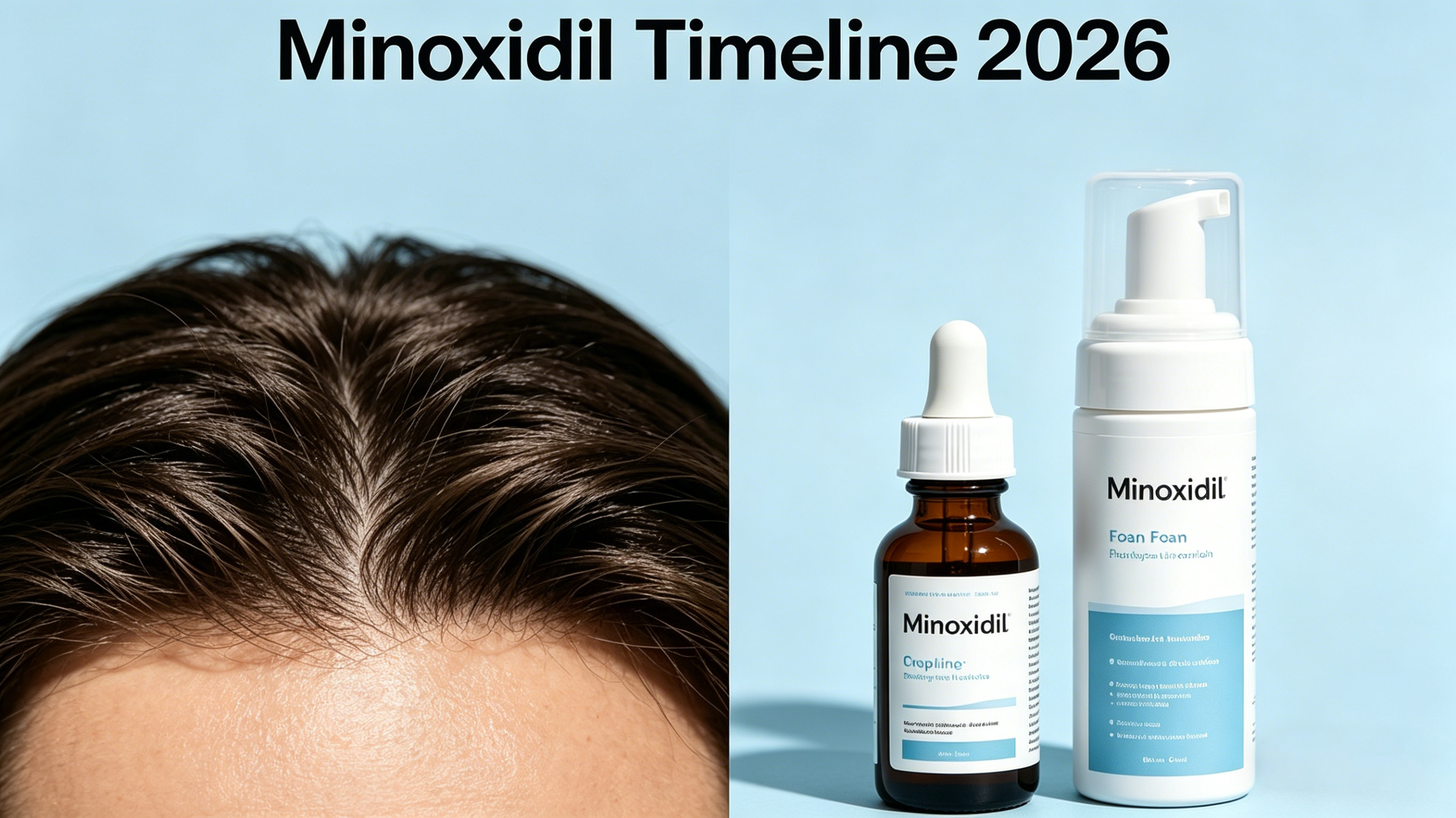
Quick Answer: Most people see initial hair regrowth results from topical minoxidil within 2–4 months of consistent daily use, with peak density improvements appearing at 6–12 months. The process is not linear — expect temporary shedding in the first 2–8 weeks before visible progress begins.
If you've started minoxidil and found yourself watching your hairline in the mirror every morning, you're not alone. The most Googled question among new minoxidil users isn't about dosage or side effects — it's about time. When does this actually start working?
The honest answer requires understanding what minoxidil is doing at each stage of the hair growth cycle, why the timeline feels counterintuitive, and what "working" actually looks like month by month.
This guide covers the complete minoxidil timeline from day one through 12 months, including the biology behind the shedding phase, what signs actually confirm the treatment is working, and how to maximize results at each stage.
How Minoxidil Works: The Biology Behind the Timeline

Before tracking results week by week, it helps to understand why minoxidil takes months to show visible change. Hair follicles don't respond to treatments the way skin does — follicle biology runs on its own multi-month cycle that determines every outcome on this timeline.
The Four Phases of Hair Growth
Each follicle on the scalp independently cycles through four phases:
- Anagen (growth phase): Active hair production lasting 2–7 years. About 85–90% of your scalp hairs are in this phase at any time.
- Catagen (transition phase): A brief 2–3 week period where growth stops and the follicle prepares to rest.
- Telogen (resting phase): The follicle lies dormant for approximately 2–4 months. Around 10–15% of hairs are in telogen at any given time.
- Exogen (shedding phase): The old hair physically detaches and falls out as a new anagen hair begins growing underneath.

In androgenetic alopecia (pattern hair loss), an increasing proportion of follicles spend longer in telogen and produce progressively thinner, shorter hairs with each cycle — a process called follicular miniaturization.
What Minoxidil Actually Does
Minoxidil works primarily as a potassium channel opener and vasodilator. It widens blood vessels around the hair follicle, improving blood flow, oxygen delivery, and nutrient transport to the follicle cells. It also promotes the production of VEGF (vascular endothelial growth factor), which encourages the growth of new capillary networks around follicles.
Critically, minoxidil shortens the telogen phase — cutting it from the normal 2–4 months down to approximately 1–2 days — and extends the anagen phase, which encourages thicker, denser hair production. Once converted to its active form, minoxidil sulfate (by the enzyme SULT1A1 in the hair follicle), it directly stimulates follicle cells to re-enter the growth phase.
This mechanism explains everything about the timeline. Because minoxidil is forcing resting follicles to restart their growth cycles, the effects take months to accumulate — and the first visible effect is often more shedding, not less.
The Minoxidil Timeline: Week by Week, Month by Month
Weeks 1–2: Adjustment Phase
Most users experience no visible change in the first two weeks. Some notice mild scalp tingling or slight redness at the application site — this is a normal response to the vasodilatory effect of minoxidil and typically resolves within a few days of consistent use.
A small percentage of users notice the start of increased hair shedding even this early. This is the beginning of the "dread shed" — the most misunderstood stage of minoxidil treatment.
What to do: Apply consistently once or twice daily as directed. Do not wash hair for at least 4 hours after application, as approximately 75% of topical minoxidil absorbs within the first four hours.
Weeks 3–8: The Shedding Phase ("Dread Shed")
This is the stage where most people quit — and the stage that is most predictably misinterpreted as treatment failure.
Minoxidil accelerates the transition of resting (telogen) follicles into active growth (anagen). To start this new cycle, the old hair shaft must be shed first. In androgenetic alopecia, a greater-than-normal percentage of follicles are already in telogen — meaning minoxidil can trigger a synchronized release of multiple resting hairs at once. This is called "follicular flushing," and it is the mechanism behind the dread shed.
In a randomized controlled trial of 5% minoxidil, researchers documented a temporary increase in hair shedding in the first 2–12 weeks, followed by a return to baseline and progressive improvement. The shedding is not hair loss — it is old hairs being replaced by new, healthier ones that are already growing underneath.
Key insight: If you are shedding at 4–6 weeks, minoxidil is very likely working. The shed signals follicles are transitioning from telogen to anagen. A 2025 retrospective study confirmed that early shedding is a positive predictor of treatment response.
What to do: Do not stop treatment. Shedding during this phase is temporary and typically resolves by weeks 8–12. Keep a weekly scalp photo log under consistent lighting — this baseline will be valuable when comparing results at month 4.
Weeks 8–12: Early Growth Signals
By months 2–3, the shedding phase typically resolves. Most users stop experiencing the elevated shed and return to near-baseline daily hair loss. The next visible sign is not dramatic regrowth — it is the appearance of fine, short vellus hairs in thinning areas.
These fine hairs are easy to miss without close examination and good lighting. They are softer, lighter in color, and shorter than terminal (mature) hairs. Many users at this stage report that their hair "looks the same," but if they compare scalp photos from week 1 to week 10, the difference in fine hair coverage is often visible.
Clinical trials reveal that both men and women with androgenetic alopecia can start seeing new hair growth within 6–8 weeks of starting minoxidil treatment, with hair growth peaking 12–16 weeks after treatment start.
What to do: Compare your scalp photo log. Look for new fine hairs in the parting line or along the hairline. If you're applying manually with a dropper or spray, ensure you're actually reaching the scalp surface in thinning areas — hair can absorb the solution before it contacts the follicle.
Months 3–4: Visible Progress Begins
This is the range where most clinical measures begin to show statistically significant change. Initial results from minoxidil are typically observable after 2–4 months of regular use, though more significant results often appear after 6 months or longer.
At this stage, the fine vellus hairs from earlier begin transitioning to terminal hairs — thicker, pigmented, and more durable. Hair density in thinning areas increases measurably. Many users report their hair "looks fuller" when styling, particularly at the crown or vertex.
Importantly, some studies found that combining minoxidil with low-level light therapy (LLLT) at 630–660nm can accelerate this timeline — showing statistically significant improvement as early as 2 months in the combination group, versus 4 months for minoxidil alone.
What to do: If you haven't seen any change by week 12 and haven't experienced a shedding phase, consult a dermatologist. The absence of both shedding and growth can indicate either application error (solution not reaching the scalp) or low SULT1A1 enzyme activity — which determines whether topical minoxidil can be activated in the follicle.
Months 4–6: Significant Regrowth Phase
Hair becomes thicker and denser. Most users experiencing a positive response to minoxidil report this as the phase where results become undeniable — thicker ponytails, wider parts that look narrower, visible coverage improvement at the crown.
A 12-month study of 5% topical minoxidil in 984 patients with male pattern hair loss found that areas of alopecia had shrunk in 62% of patients after one year, with substantial measurable improvement concentrated in the 4–6 month window.
Hair count per unit area increases, and the ratio of terminal to vellus hairs improves. At this stage, the difference between before/after scalp photos is typically pronounced enough to be visible to other people.
What to do: Continue at exactly the same frequency. This is when many users make the mistake of reducing to once daily because results are visible — do not. Consistency at this stage determines whether gains continue or plateau.
Months 6–12: Consolidation and Peak Results
Regrowth continues to consolidate. Full results from topical minoxidil are typically visible after 12 months of consistent use. Maximal regrowth appears approximately 12 months after treatment start, after which the primary goal shifts from regrowth to maintenance.
At the 12-month mark, users can assess whether topical minoxidil alone is sufficient for their level of hair loss or whether combination therapy (adding finasteride, oral minoxidil, LLLT, or PRP) could further improve outcomes.
Minoxidil Timeline at a Glance
| Time Period | What's Happening | What You See |
|---|---|---|
| Weeks 1–2 | Adjustment; vasodilation begins | No visible change; possible tingling |
| Weeks 3–8 | Telogen-to-anagen transition; dread shed | Increased shedding — normal, expected |
| Weeks 8–12 | Shedding resolves; vellus hairs appear | Fine soft hairs in thinning zones |
| Months 3–4 | Vellus-to-terminal conversion begins | Initial visible density improvement |
| Months 4–6 | Significant regrowth phase | Clear hair thickening; coverage improves |
| Months 6–12 | Consolidation; peak results | Maximum density; results visible to others |
| 12 months+ | Maintenance phase | Continued use required to sustain results |
Why 90% of People Quit Before Seeing Results
The most important statistic in hair loss treatment is not clinical efficacy — it's dropout rate. Multiple studies document that approximately 86–90% of topical minoxidil users discontinue treatment before reaching the 3–4 month threshold where results become visible.

The reasons are predictable and almost entirely related to the timeline:
- The dread shed panics users — increased shedding at weeks 3–8 reads as "it's making things worse," leading to abandonment before the growth phase begins.
- No visible results at 4–6 weeks — users expect pharmaceutical-speed results and interpret the absence of change as failure.
- The application is inconvenient — twice-daily application with a dropper or foam, with a 4-hour no-wash window each time, creates enough daily friction that users skip doses and eventually stop.
- Messy application — liquid minoxidil drips onto the hairline and hands; foam leaves residue; neither method reliably reaches the scalp through dense hair.
Understanding the full timeline before starting treatment is the single most effective intervention against early dropout. Knowing that shedding is expected — and a sign of efficacy — transforms a perceived failure signal into a confirmation that treatment is working.
How to Maximize Results at Each Stage
Application Technique Matters More Than Most Users Realize
Only approximately 1.4% of topical minoxidil applied on a healthy scalp is actually absorbed systemically. But more practically relevant is that application errors — too much solution sitting on hair fibers instead of the scalp, uneven distribution, insufficient contact time — reduce effective scalp delivery and slow visible results.
The gold standard application method:
- Part hair to expose the scalp in thinning areas
- Apply exactly 1ml directly to the scalp surface (not the hair)
- Do not rinse for at least 4 hours
- Wash hands thoroughly after application

Scalp health and skin integrity affect absorption significantly. Product buildup, excess sebum, or dry scalp conditions reduce penetration. Applying to a clean scalp improves absorption.
Combine Minoxidil with LLLT for Faster Results
A three-arm randomized controlled trial comparing LLLT alone, minoxidil alone, and combination treatment found that the combination group achieved +41% hair count improvement at 24 weeks, versus +22% for LLLT alone and +19% for minoxidil alone. The mechanisms are complementary: minoxidil extends the anagen phase via potassium channel activation, while LLLT at 630–660nm stimulates follicle mitochondria and accelerates the telogen-to-anagen transition.
More clinically significant: the combination group showed statistically significant improvement at 2 months — two months before the minoxidil-alone group. For users focused on the timeline, this is the most actionable adjunct to standard minoxidil treatment.
The effective wavelength range for hair LLLT is 630–680nm (red light). Devices outside this range do not provide the same benefit. The 660nm wavelength specifically interacts with cytochrome C oxidase in follicle cell mitochondria, releasing nitric oxide and increasing cellular energy production.

Consistency Is the Single Most Important Variable
Research consistently identifies non-compliance — not using minoxidil twice daily as directed — as the most common reason patients do not see expected results. Even one missed application per day translates to roughly 25% fewer doses per year than twice-daily protocol, directly compressing the efficacy window.
Habit-stacking strategies show the highest adherence rates: placing the applicator next to the toothbrush, applying immediately after the evening shower, or using a device that integrates dosing confirmation. Building a time-cued trigger (same action, same location, same time each day) reduces the decision fatigue that causes missed doses.
What to Do If Minoxidil Is Not Working After 6 Months
If 6 months of consistent, correctly applied topical minoxidil has produced no visible change and no shedding phase, several explanations are worth investigating:
- Low SULT1A1 enzyme activity. Topical minoxidil requires conversion to minoxidil sulfate by the SULT1A1 enzyme in the follicle. Genetic variation in SULT1A1 activity creates a spectrum of "responders" and "low-responders" to topical minoxidil. Low-responders may see dramatically better results from oral minoxidil, which bypasses the local enzyme bottleneck by converting in the liver and delivering the active form systemically.
- Application reaching hair, not scalp. This is the most common correctable cause of poor response. Liquid minoxidil absorbed by dense hair fibers never reaches the follicle. Using a parting tool, applicator with a directional nozzle, or micro-mist delivery ensures solution contacts the scalp.
- Underlying cause of hair loss is not androgenetic alopecia. Minoxidil is specifically effective for androgenetic alopecia (pattern hair loss). Hair loss from thyroid conditions, nutritional deficiency, alopecia areata, or scarring alopecias has different underlying mechanisms and does not respond to minoxidil in the same way.
- Combination therapy needed. For moderate-to-severe androgenetic alopecia, topical minoxidil alone often provides partial response. Adding finasteride (for men), spironolactone (for women), or oral low-dose minoxidil can address the DHT-driven follicular miniaturization that topical minoxidil does not directly target.
Frequently Asked Questions(FAQ)
Does minoxidil work for everyone?
No. Response rates vary by individual, extent of hair loss, and time on treatment. In clinical studies, approximately 60–62% of users show measurable improvement after 12 months of consistent use. Non-responders may benefit from oral minoxidil or combination therapy. There is no reliable clinical predictor of response other than trying treatment and evaluating at 6–12 months.
Can I use minoxidil once a day instead of twice?
Once-daily application is better than no application, but twice daily produces superior results. 5% once-daily application has been shown equivalent to 2% twice-daily for female pattern hair loss in some formulations, but for most liquid 5% formulations, twice daily remains the standard. Consistency of schedule matters more than exact timing.
What happens if I stop minoxidil after seeing results?
Hair loss resumes within 3–4 months of discontinuing topical minoxidil. The regrowth achieved during treatment is dependent on continued use — minoxidil does not permanently alter follicle biology. This is why adherence across the full treatment period is so critical to long-term outcomes.
Is oral minoxidil as effective as topical?
A meta-analysis of four randomized controlled trials comparing oral and topical minoxidil found no significant difference in hair density or hair diameter outcomes. However, oral minoxidil carries a higher incidence of hypertrichosis (unwanted body hair growth) and is off-label for hair loss (not FDA-approved for this indication). Many dermatologists recommend it for patients who are low-responders to topical treatment or who cannot maintain consistent topical application.
Does the shedding phase mean minoxidil is definitely working?
A 2025 retrospective study confirmed that the initial shedding phase is a positive predictor of treatment response — users who shed during weeks 3–8 show better outcomes at 6 and 12 months than those who do not. That said, absence of a shedding phase does not necessarily indicate treatment failure; not all users experience pronounced shedding.
Reviewed April 2026. Clinical data sourced from peer-reviewed publications including PubMed, GoodRx clinical resources, Wimpole Hair Transplant Clinic clinical guides, and JCAD systematic reviews of LLLT in androgenetic alopecia.
Share:
How to Apply Minoxidil the Right Way for Better Absorption
Red Light Therapy for Hair Loss: Does It Actually Work? The Science, Evidence, and How to Use It